Things to See in Lucca
Lucca is renowned all over the world for its city walls, erected between 1504 and 1645. An important example of military architecture, the walls, which have never been used for defensive purposes, have been transformed into a charming promenade around the city.
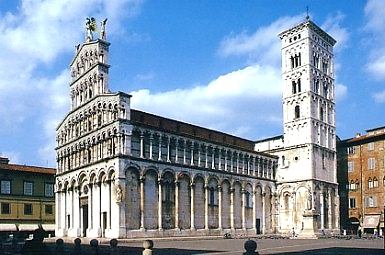
Lucca is called the hundred-church town because of its numerous buildings of worship, the most important being the Cathedral of San Martino, the church of San Giovanni and Santa Reparata, San Michele in Foro and San Frediano.
Very famous is also Via Fillungo, with its Medieval buildings. The street leads to Piazza dell`Anfiteatro, which today is called Piazza del Mercato, where once stood the Roman amphitheatre.
The Torre Guinigi (Guinigi Tower), once the house of Paolo Guinigi, who governed Lucca from 1400 to 1430, and the Teatro del Giglio are worth a visit, too.
Comics fans can visit the Museo Nazionale del Fumetto (National Comics and Illustrations Museum).
|
|
| The walls of Lucca - The present town walls -the most recent of the city ramparts that defended Lucca- still surround the historical city centre with an uninterrupted path of 4,200 metres. At the beginning of the 16th c, the town began to feel the need of a new ring of walls, aiso in consideration of the expansionistic policy of the Medici who aimed at making Florence the capital town of a wider state than how it had been until then. To attain their goal the Florentines ... The walls of Lucca |
| | Cathedral of S. Martino - Situated in the homonymous square, the Cathedral dedicated to San Martino is Lucca`s most important church. It is a Romanesque church, whose construction began in 1060 and which underwent remarkable reworkings during the 14th and 15th centuries. The façade is by Guidetto da Como, who in his work was highly influenced by Pisan architecture. The sculptor completed it in 1204. The portico is decorated with reliefs of the "Histories of San Martino" and the "Months" and with other works of art attributed to Nicola Pisano. The interior of the Cathedral is in Gothic style and is decorated with interesting sculptures, paintings and ... Cathedral of S. Martino |
| | The ancient roman amphitheatre - This unique square on the spot where the Ancient Roman amphitheatre originally stood is what is left, along with the few remains that still can be seen, of the presence of the Romans n Lucca who arrived in about 180 BC and saw the transformation of the town from a "castrum" to a Municipality with the right to mint its own coins. This valuable seat of entertainment with its two rows of arches decorated with a marble covering and ... The ancient roman amphitheatre |
| | The Guinigi Tower - The Guinigi Tower, emblem of the importance of one of the most famous families of Lucca rises 44,25 metres proud above the town, crowned by its unusual plume of centuries-old holm trees on its summit. Next to the palace of the same name which belonged to Michele, Francesco and Nicolao Guinigi, the tower is the last remaining testimony of the 250 towers which once enriched the city in medieval times and adds the final perfect touchg medieval atmosphere which Via S.Andrea has retained, perhaps because of the warm colours of too brick and the stone ... The Guinigi Tower |
| | S. Michele in Foro - The first historic evidence connected to the church of San Michele in Foro dates back to 795. The name of the church is due to the fact that it was built on the ruins of the ancient Roman forum. In 1443 the church passed in the hands of the Benedictine monks, who began to build the edifice we can see today. The works continued until the 16th century. In the 13th century Guidetto da Como, who had already worked to the building of the cathedral of San Martino ... S. Michele in Foro |
| | Museo Nazionale del Fumetto - Located in the historic downtown district in the quiet Piazza San Romano, next to the city walls between the Fortresses of Santa Maria and San Paolino is the MUF, or the Museo Nazionale del Fumetto e dell`immagine (National Comics and Illustrations Museum), realized on the basis of a cultural project by Gianni Bono, housed in the city complex that was once the Lorenzini barracks, now fully restored by Architect Pietro Carlo Pellegrini. In addition, some of the Museum`s temporary displays are held in the adjacent Church of San Romano, now a community auditorium ... Museo Nazionale del Fumetto |
| | Teatro del Giglio - In 1675, on the express wish of the General Council of the Republic of Lucca the theatre of S. Girolamo was founded on the remains of an ancient convent. It worked uninterruptedly as the Public Theatre up until 1808 despite a devasting fire in 1688. Soon afterwards the architect Giovanni Lazzarini was given the task of restoring it by Maria Luisa di Borbone adapting it to the new needs of the city: in 1817 the Teatro del Giglio was founded taking its name from the flower which was the ... Teatro del Giglio |
| | Torre delle Ore - In 1390 the General Council of Lucca decided to have built an "orologio bonum, sufficienter aptum et bene distinguentes tempus per horas" which was to be placed on the tower of the "Quartigiani" or "Diversi" in Via Fillungo However, the tower was not acquired until the year 1490 when it was renamed the Civic Tower and when a clock-face was placed on the tower so that the time could be seen and not simply heard as before with the striking of the bell. The working mechanism of this clock underwent changes throughout ... Torre delle Ore |
| | House Puccini - It was approximately in 1815 when the Puccini family moved into the house in Corte S. Lorenzo, after the premature death of Domenico, talented opera composer, on the wishes of his widow Angela Cerù. In that house, on the 22nd December 1858 Giacomo Puccini was born, the last of a great dynasty of musicians beginning with Giacomo senior in 1712. Giacomo`s parents, Michele Puccini and Albina Magi, were already living in the house together with the grandmother Angela, sisters Otilia, Tomaide, Maria Nitteti and Iginia, their domestic help; a true gynaeceum to which were later added Ramelde and Macrina ... House Puccini |
| | Lucca Photographic Archive - Inside Villa Bottini resides the Commune of Lucca Photographic Archive (AFL), started in 1979, when the Commune took ownership of the archive of Luccan photographer Ettore Cortopassi (1895-1989). The archive comprises 220,000 images: 40,000 negatives of large format on glass or flat film; 145,000 negatives on rolled film; 35,000 positives printed by Cortopassi himself or, in any event, in his laboratory ... Lucca Photographic Archive |
| | Via Fillungo - The main street in Lucca historical centre, where you can shop in elegant and fashionable shops, is lined with ancient tower-houses and the residences of Lucca noble families, dating back to the 15th and 16th centuries. Among them, the most important are Palazzo Cenami, built in the early 16th century by Nicolao Civitali, and Casa Barletti-Baroni, dating back to the 13th century. In via Fillungo stand the church of San Cristoforo and the basilica of San Frediano, as well. The church of San Cristoforo was built in the 12th century on the remains of a structure dating back to the previous century. The façade presents a Gothic portal ... Via Fillungo |
| | SS. Giovanni and Reparata - The church of Santa Reparata and the contiguous baptistery of San Giovanni have a particular history. The church of Santa Reparata was built in the 12th century on a pre-existing building dating back to the 4th century, which had been Lucca`s Cathedral until 725. In the 17th century, the church underwent severe reworkings. The contiguous baptistery of San Giovanni dates back to the 14th century. In 1808, both buildings were deconsecrated by order of Elisa Baciocchi, who ... SS. Giovanni and Reparata |
| | Santa Maria dei Servi - The Convent of Santa Maria dei Servi site of the Agora, and the immediately adjacent church were built in the 14th century by the Order of the Servants of Mary. The architectural complex consists of two cloisters, a larger one with porticoes and columns, and a smaller cloister, next to the Oratory of San Lorenzo, built in 1480 (currently the conference room). Maria Luisa of Bourbon returned the convent, closed under the Baiocchis, to the Lateran Canonry, until in 1866 it was once again ... Santa Maria dei Servi |
| | Botanical Garden - In 1820 the Duchess Maria Luisa of the house of Bourbon, decided to create a botanical garden for scientific purposes and established an experimental laboratory in collaboration with the University College of Lucca under the direction of Bernardini Orsetti, inside the walls, between Gate Elisa and the Gate of Saint Peter, in the area known as the Roman "Piaggia"; burial place for the executed, the interdicted and the heretics, and later in the 16th and 17th centuries used as football fields. Throughout the years the garden has enriched its collection of rare and exotic plants which were planted also in the parks of the villas of the local nobility. A small lake adorns ... Botanical Garden |
| | Villa Bottini - Set in a charming garden, Villa Bottini lies outside the old medieval town walls just two steps from San Gervasio and Protasio Gate and the moat, which marked the boundaries of the old town. Villa Bottini or rather Villa Buonvisi - Bottini, to the remind of the Buonvisi family who had this villa erected in the mid 16th century and kept it as their property until the beginning of the 1800. Once Girolamo Buonvisi, the last heir, had died, Elisa Buonaparte acquired it. Unfortunately, she could not enjoy the building for very long, since already in 1814, she had to leave Lucca because of the events ... Villa Bottini |
|
|
|
|